A page from our archives: animals, activities and schedules reflect the publication date. The farm is currently closed to visitors; our mobile farm remains available.
Food forest is a type of orchard mimicking natural forests. The difference is that in a food forest we try to grow as many useful to humans plants as possible, while maintaining natural balance. A food forest, also known as a forest garden, typically has seven layers:
Canopy: Large fruit and nut trees
Understory: Smaller fruit and nut trees
Shrub: Fruit bushes like berries and currants
Herbaceous: Herbs and plants like kale, rhubarb, and asparagus
Rhizosphere: Root crops like potatoes, garlic, and onions
Groundcover: Edible plants like strawberries and clover
Vines: Climbing plants like peas and beans
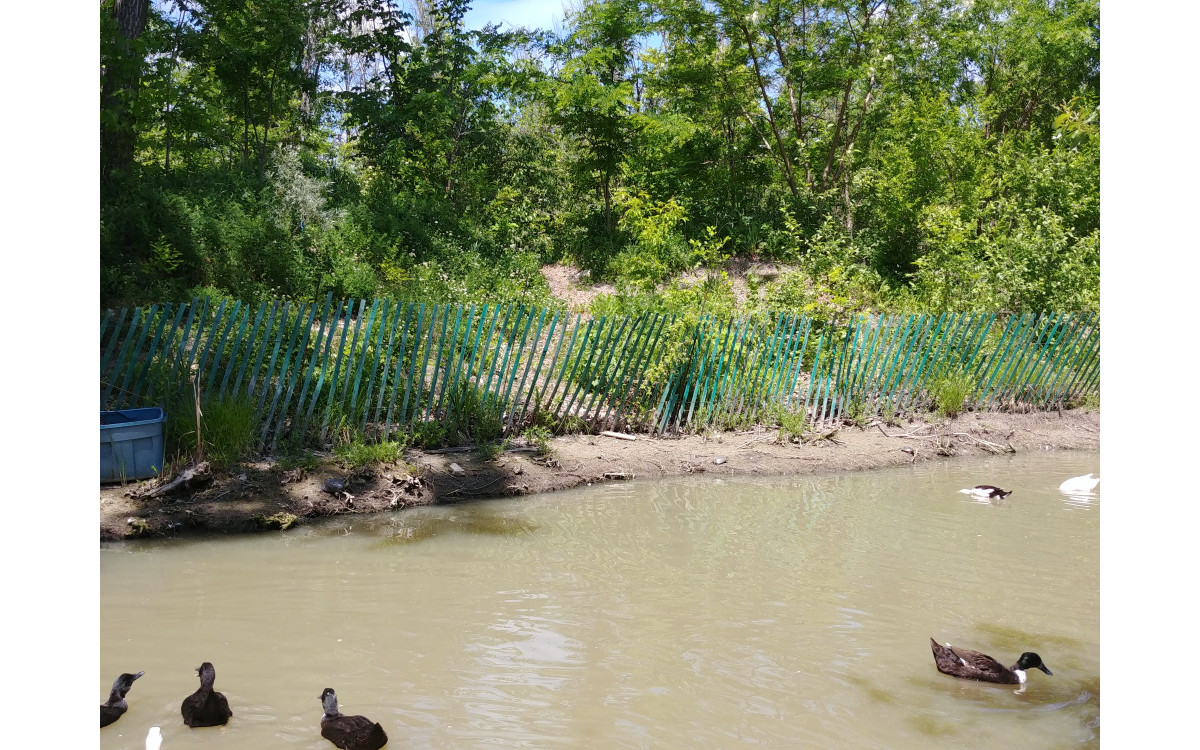
At Project PACE we have a small food forest on a hill beside the pond.
For canopy trees now we use black locusts. Those trees grow very fast. Also they have multiple functions. They are:
major producers of nectar for honeybees
Nitrogen fixers for other plants
Separators between nut trees and apple trees
Sparse shade providers for lower layers
Favourite food for goats and sheep
Good timber wood for building paths, raised beds and other projects
In the understory we have apple, pear, plum trees, pawpaws, young nut and oak trees.
In the shrub layer we have black and red currants, bush cherries, aronia, seaberries (also nitrogen fixers), blueberries and juneberries.
In the herbaceous layer we use squashes and pumpkins, though it’s a lot of plants that can be added there.
For groundcover we have clovers.
We don't yet have an established vine layer and don’t plant root crops.
We also account for plant preferences and site microclimate when planting. On dryer south - facing slopes we plant hardy plants like seaberries or bush cherries. On a more gentle microclimate of west-facing slopes we plant apples, plums, pears and blueberries.
The food forest changes as it grows. This is called evolution. Oaks and walnuts overgrow black locusts and become a new canopy layer that also serves as a windbreak.
Apple, plum and pear trees mature and create a better environment for bushes and herbs that grow beneath them. Each year adds more compost to the soil creating conditions for root crops, medicinal plants and mushrooms.
With all that, wild plants like ashes, summack, buckthorn, wild parsnip, etc. find a way into the garden. For me it’s an indication of an available niche. Buckthorn can be replaced with seaberry, ashes with fruit trees, sumac - with pawpaw. There is always something to add in the food forest!
For me the best thing food forest gives - is the pleasure to be there and enjoy it. It’s to watch for the first spring flowers to appear, smell the aromas of flowering black locust, taste the first sour cherries and juneberries and wait for the first apples to ripen. It's the never-ending game of guessing what life wants to be here at this place. The more I play the more I like it!
One more story?